
Why SiC Is at the Core of Electric Vehicles
To realize a sustainable future, electronic designers and engineers working on powertrains and high-voltage systems are deeply interested in extending EV range and reducing design complexity and external-component cost…

Automotive electrification still faces many technical challenges, and OEMs are focusing on overcoming them. To advance a sustainable future, engineers want to maximize EV range while cutting design complexity and external-component cost. Maximizing EV autonomy by reducing complexity and cost is a primary goal of the modern automotive vision. The EV ecosystem is profoundly shaped by silicon-carbide (SiC) power electronics, which deliver multiple performance advantages.
The automotive industry is undergoing a technology transformation. The transition from internal-combustion-engine (ICE) vehicles to EVs is spreading rapidly. At the same time, semiconductor innovations in traction-inverter systems and power conversion are helping overcome key barriers and enable wider adoption. Driven by global CO2-reduction regulations, EVs are expected to be widely adopted by 2030. Designers of high-voltage applications such as traction inverters now face the challenge of optimizing system efficiency and reliability within tight space constraints.
Today, automakers can produce reliable SiC- and IGBT-based traction inverters with advanced SiC monitoring, protection, and diagnostic functions to achieve functional safety. The latest generation of highly integrated SiC gate drivers maximizes EV autonomy. Achieving greater EV range also requires more efficient traction inverters. The characteristics of SiC gate drivers allow designers to raise power density, reduce design complexity and external-component count, lower cost, and meet strategic goals around functional safety and overall performance—maximizing autonomy and designing ever more efficient traction inverters.
Power-device technology specifications and target markets
SiC gate drivers help deliver more functionality with less power, making them ideal for many markets—especially today’s automotive sector—and offering advantages across a wide range of applications.
Efficient power conversion depends on the power semiconductors used in the system. As device technology improves, high-power applications are becoming more efficient and compact. Such devices include IGBTs and SiC MOSFETs, which combine high voltage and current ratings with low conduction and switching losses, making them ideal for high-power applications. Above 400V, devices must be rated above 650V to provide adequate safety margin. Industrial motor drives, EVs and hybrids, traction inverters, and solar inverters span power levels from a few kW to MW and beyond.
Power levels of SiC MOSFETs and IGBTs are very similar but diverge as frequency increases. SiC MOSFETs are increasingly common in PFC power supplies, solar inverters, EV/HEV traction inverters, motor drives, and rail traction. IGBTs remain more common in motor drives, UPS systems, string and central solar inverters below 3 kW, and EV/HEV traction inverters.
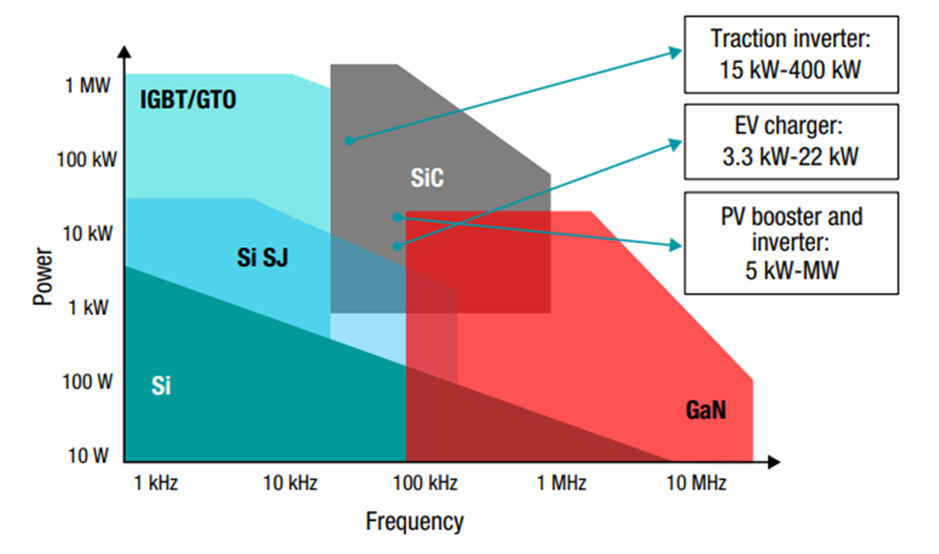
圖1:根據功率水準和頻率劃分的功率半導體元件應用示意圖。
(來源:德州儀器)
Compared with silicon MOSFETs and IGBTs, SiC MOSFETs offer several system-level advantages. Wide-bandgap (WBG) materials have very attractive properties; compared with silicon-based systems, SiC’s material characteristics translate directly into system-level benefits—smaller size, lower cost, and lighter weight. SiC MOSFETs are gradually replacing silicon power devices.
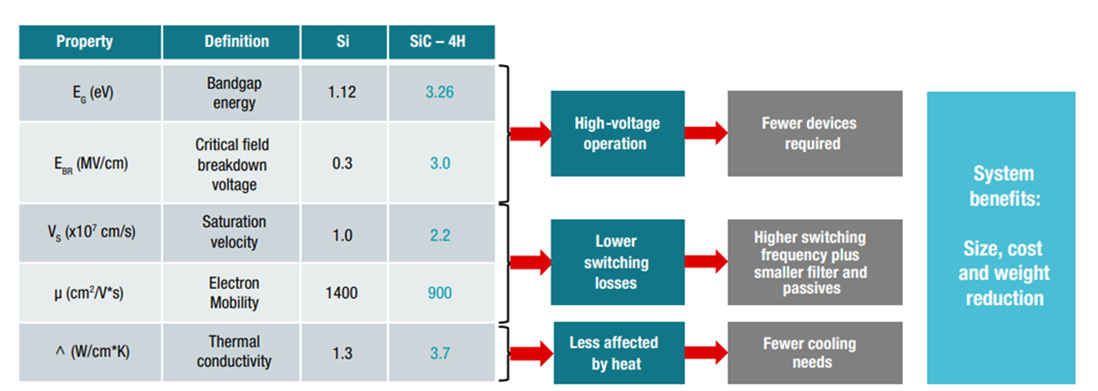
圖2:功率元件材料的技術特性。
(來源:德州儀器)
矽MOSFET、矽IGBT和SiC MOSFET都可用於電源應用,但在功率水準、驅動方法和工作模式上有所不同。功率IGBT和MOSFET在閘極採用電壓驅動,因為IGBT在內部是一個驅動雙極結型電晶體的MOSFET。由於IGBT具有雙極特性,因此它們能以較低的飽和電壓承載較大的電流,從而實現較低的傳導損耗。
MOSFET的傳導損耗也很低,但取決於元件的漏源導通電阻(RDS(on))。矽MOSFET承載的電流比IGBT小,因此IGBT用於大功率應用。MOSFET用於高頻應用,在這些應用中,高效率是最重要的。
SiC MOSFET在元件類型上與矽MOSFET相似。不過,SiC是一種WBG材料,其特性使這些元件能夠在與IGBT相同的大功率水準下工作,同時還能實現高頻率開關。這些特性轉化為重要的優勢,包括更高的功率密度、更高的效率和更低的散熱。隨著功率水準的增加,例如在驅動電動車馬達的牽引逆變器中,由於高極限工作溫度和容許結溫,IGBT等矽功率元件的散熱管理變得更加複雜。這就需要將冷卻元件整合到驅動系統中,尤其是在功率可能超過100kW的牽引逆變器中。然而,這些冷卻元件會增加車輛的尺寸、重量和成本。相比之下,SiC的容許結溫要高得多。此外,在給定電池容量的情況下,SiC斷路器在牽引逆變器系統中的效率比IGBT提高了10%。
SiC在車用電力電子系統中的重要性
SiC, a WBG semiconductor, has become a successful technology in recent years with the potential to reshape the sustainable transportation ecosystem globally. Using SiC for power switching improves EV powertrain power density and switching efficiency. Key advantages of SiC-based power electronics include:
.Higher power density, improving EV powertrain performance
.Operation at higher temperatures than conventional silicon devices
.Greater current-carrying capability
.Higher switching frequencies
.High blocking voltage
.Thermal conductivity 2–3× higher than silicon
.Longer driving range
.Faster charging
.Lower cost
SiC power devices offer up to five times the current density of silicon, enabling higher per-die power density, smaller devices, and more compact packages. As battery costs continue to drop with higher energy density, EV powertrains are also boosting power density by reducing size, weight, and cost—chiefly by maximizing use of SiC power switches, especially in on-board chargers (OBCs) and traction inverters.
In addition, SiC-based power devices can raise switching frequencies by 10×—at least 20 kHz in traction inverters and several hundred kHz in OBCs. At these higher frequencies, passive components such as capacitors and inductors can shrink significantly, enabling smaller overall systems. SiC enables higher voltage, higher power, and higher switching efficiency, simplifying high-power traction-inverter design and substantially reducing losses.
電動車系統工程師面臨的挑戰是,如何透過涉及電源轉換和WBG半導體的創新,最大限度地發揮高壓技術的潛力。電動車對更高可靠性和更高功率性能的需求不斷成長,因為效率的提高直接影響到每次充電續航里程的增加。然而,考慮到大多數牽引逆變器的效率已達到90%或更高,電動車設計人員要想大幅提高效率仍然非常困難。在電動車動力系統中使用SiC功率開關可實現更高的功率密度和開關效率。
此外,基於SiC的電力電子元件還能使電動車實現更長的行駛里程、更快的充電速度和更低的擁有總成本。還可利用SiC元件低功率損耗降低電池成本和尺寸。此外,更高的電壓可減少馬達繞組中對大量銅的需求,從而實現更小的馬達設計。這些元件尺寸和重量的減少有助於降低電動車的成本,從而大大有利於電動車的成本趨於平價,甚至優於傳統的內燃機汽車。在給定功率水準和電池容量的情況下,SiC功率元件的尺寸可以更小,從而形成具有整合推進系統的電動車子系統集群。在設計層面,透過消除或減少用於冷卻的機械塊,以及被動元件和外殼的材料用量,可以最大限度地降低系統成本。
總體而言,SiC電力電子技術正在產生巨大的全球影響。未來幾年SiC最大的細分市場肯定是電動車,這說明SiC技術市場的成長速度將超過電動車市場。
(參考原文:Why SiC Is at the Heart of E-Mobility,by Giordana Francesca Brescia)
本文同步刊登於《電子工程專輯》雜誌2024年6月號